+977-9863079150
·
info@robinlawandpolicy.com
Mon - Fri 09:00-17:00
·
Trusted By
Local & Global Clients
Consultation

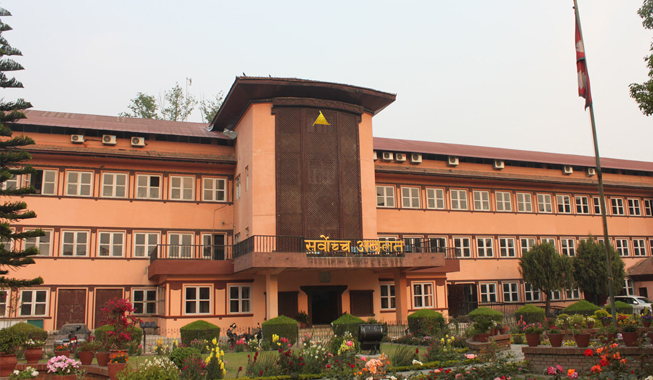
The Constitutional Bench’s Missed Opportunity: Lessons from the Supreme Court’s July 2025 Ruling

supreme_court

Published: July 11, 2025

The Case at a Glance

The Supreme Court’s Constitutional Bench recently delivered its long-awaited verdict on the legality of appointments to constitutional bodies made via ordinance during Prime Minister KP Sharma Oli’s tenure. The case concerned 52 appointments made in 2020 and 2021 without parliamentary hearings.

  • Majority (3–2): Upheld all appointments, citing the executive’s power to issue ordinances and treating procedural irregularities as minor.
  • Dissent (Chief Justice Raut, Justice Subedi): Found key procedural violations, particularly failure to notify the Speaker, and would have invalidated the first set of appointments.

Why This Matters

Instead of clarifying constitutional thresholds, such as the urgency test under Article 114 (ordinance powers) or the parliamentary hearing requirement under Article 292, the Bench leaned on technical reasoning (meeting timing and notice).

For many observers, this was a missed opportunity to strengthen:

  • Checks on executive power
  • Parliamentary oversight of key institutions
  • Public trust in constitutional adjudication

Implications for Governance and Law

  • Executive authority: The ruling leaves broad scope for governments to use ordinances for sensitive appointments.
  • Judicial role: By focusing narrowly on procedure, the Court avoided shaping the constitutional doctrine that guides separation of powers.
  • Institutional credibility: Perceptions of “administrative” rather than “constitutional” reasoning may weaken public confidence in the Constitutional Bench.

Key Takeaway for Clients and Practitioners

For those engaged in governance, compliance, or litigation:

  • Expect greater executive discretion in appointments absent clear legislative or judicial guardrails.
  • Anticipate heightened scrutiny from civil society and media over procedural integrity in public appointments.
  • Legal challenges to executive power will hinge not only on substance but on technical procedure—a lesson for both litigators and policymakers.

Conclusion

The July 2025 ruling illustrates both the power and limits of Nepal’s Constitutional Bench. While the verdict preserved past appointments, it also highlighted the Court’s reluctance to grapple with deeper constitutional principles. For law firms and their clients, the message is clear: constitutional disputes often turn on how rules are applied, not just what the rules are.

This summary is intended for informational purposes and does not constitute legal advice. For tailored guidance on constitutional or governance-related litigation, please contact us

ClientThe Car Rental Co
SkillsPhotography / Media Production
WebsiteGoodlayers.com

Project Title

Far far away, behind the word mountains, far from the countries Vokalia and Consonantia, there live the blind texts. Separated they live in Bookmarksgrove right at the coast of the Semantics, a large language ocean. A small river named Duden flows by their place and supplies it with the necessary regelialia. It is a paradisematic country, in which roasted parts of sentences fly into your mouth.