
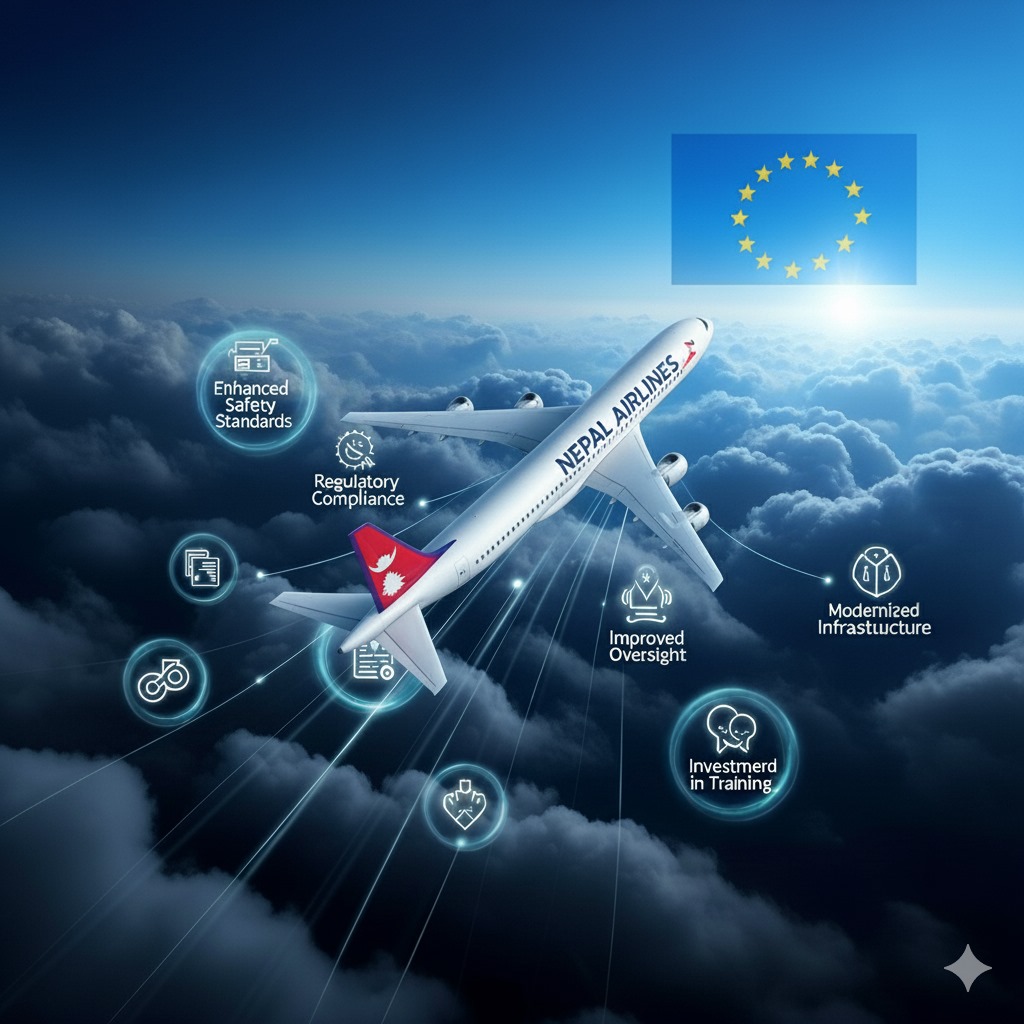
By: Ankur Nepal
Understanding the EU Air Safety List
The EU Air Safety List, commonly known as the Blacklist, is a tool created and maintained by the European Commission to ensure air travel within, into, and over the European Union remains safe. The EU Air Safety List is composed of two parts: Annex A, which sets out airlines prohibited from operating within the European Union, and Annex B, which sets out airlines permitted to operate only under specific restrictions.
The List is updated regularly (at least quarterly) and published in the Official Journal of the European Union. The List is based on Regulation (EC) No 2111/2005 (law adopted by the European Parliament and the Council of the European Union), which empowers the EU to restrict carriers that fail to meet international safety standards, often due to inadequate oversight by their home authorities.
The EU uses it as both a protective measure for passengers and a preventive tool, encouraging countries and airlines to improve safety to be removed from the List.
How Airlines End Up on the Blacklist
The process of blacklisting begins with the identification of concerns, which arises when serious safety risks are detected. These concerns may be triggered by various factors such as ICAO audits (a UN specialized agency that sets global aviation standards) that reveal a country’s failure to comply with international aviation standards, ground safety checks under the SAFA program (an EU program for inspecting non-EU airlines operating in Europe) that expose recurring technical deficiencies, or accident and incident reports that highlight systemic issues. Additionally, safety intelligence gathered from EASA (EU’s aviation safety regulator), EU Member States, or other international partners can also prompt the initiation of the listing process.
The European Commission, with technical support from the European Union Aviation Safety Agency (EASA), collects and analyzes evidence. The focus is not only on individual airlines but also on whether the national aviation authority can ensure proper safety oversight.
The evidence is subsequently submitted to the EU Air Safety Committee (ASC), which is composed of safety experts from all 27 EU Member States, with the participation of EASA and the European Commission. During the process, airlines or their national regulators are invited to present their case. The Committee examines corrective action plans, training initiatives, and oversight reforms, and deliberates on whether the identified risks are specific to an airline or systemic to a country’s entire aviation system.
Based on the findings of the ASC, the European Commission prepares a proposal. Airlines that are subject to a complete ban from operating within EU airspace are placed in Annex A of the Air Safety List, while airlines that are allowed to operate only under specific restrictions, such as being limited to certain aircraft types, are placed in Annex B.
The European Commission formally adopts the decision, and the updated Air Safety List is published in the Official Journal of the European Union. At this stage, the decision becomes legally binding across all EU member states.
The Air Safety List is not static. By law, it must be reviewed at least every three months. Airlines and countries can be added, removed, or shifted between Annex A and Annex B depending on safety performance and reforms.
Nepal’s Long Struggle with the Blacklist
Following the latest update, a total of 169 airlines are banned from operating in EU skies, reflecting the European Union’s strict stance on aviation safety. Out of these, 142 airlines from 17 different states have been banned primarily because their national aviation authorities were found to have inadequate safety oversight, meaning the regulators in those countries could not guarantee compliance with international standards.
In addition, 22 airlines certified in Russia and five individual airlines from other countries were blacklisted due to serious safety deficiencies identified during inspections and reviews.
Significantly, all 20 airlines licensed by the Civil Aviation Authority of Nepal (CAAN) remain on the blacklist, underscoring ongoing concerns about Nepal’s regulatory structure and persistent safety challenges.
In 2009, the International Civil Aviation Organization (ICAO) also had issued a Significant Safety Concern (SSC) against Nepal, pointing to serious deficiencies in the safety oversight functions of the CAAN. The primary issues raised were related to personnel licensing, pilot training standards, and the effectiveness of regulatory oversight mechanisms.
In response, Nepal undertook a series of reforms aimed at strengthening its aviation regulatory framework and addressing the shortcomings highlighted by ICAO. As a result of these efforts, the SSC was officially removed in 2013, signaling that Nepal had made measurable progress in aligning its aviation oversight with international standards, although broader challenges in safety enforcement still remained.
In 2013, the European Union blacklisted all Nepali airlines, a ban that has remained in place ever since. The core reason behind this decision lies in the structural weakness of Nepal’s aviation governance, as the CAAN functions both as a regulator and a service provider, creating a fundamental conflict of interest. In practice, this means that the same authority responsible for enforcing safety standards is also in charge of operating airports and providing air navigation services, undermining effective oversight. As a consequence of the blacklist, Nepali airlines are prohibited from flying to any EU member state, significantly restricting their international operations and damaging the country’s aviation credibility.
Learning from the Philippines
A similar case can be seen with the Philippines, which was blacklisted by the European Union in 2010 after the Civil Aviation Authority of the Philippines (CAAP) was found to have serious deficiencies in safety oversight. Much like Nepal’s CAAN, CAAP at that time lacked the institutional strength and technical capacity to ensure compliance with international safety standards, particularly in areas of pilot licensing, airline certification, and regulatory enforcement. As a result, all Philippine carriers were banned from EU airspace.
However, unlike Nepal, the Philippines undertook structural reforms: CAAP was strengthened as an independent regulator, aviation inspectors were trained and certified to ICAO standards, and airlines were required to implement robust Safety Management Systems (SMS). These efforts led to a gradual lifting of the ban, Philippine Airlines was removed in 2013, Cebu Pacific in 2014, and by 2015, all Philippine airlines were cleared to operate in the EU once again. This demonstrates how regulatory reform and genuine oversight improvements can pave the way for a country to exit the blacklist and restore international aviation credibility.
Can Nepal Exit the Blacklist?
In context of Nepal, there have been repeated attempts by the Government of Nepal and CAAN to get it removed. The problem is not that no effort has been made, but that the EU considers them incomplete or inconsistently enforced. Nepal introduced the Nepal Aviation Safety Plan (NASP 2023–2025), which aligns with ICAO’s Global Aviation Safety Plan. The strategy places special focus on key risk areas such as runway safety, prevention of Controlled Flight into Terrain (CFIT), and enhancing accident investigation capacity.
Regulatory reforms have also been a priority. CAAN issued directives on Flight Time, Duty Periods, and Rest Periods (2009, updated 2023) to tackle pilot fatigue and align with international standards set by ICAO, the FAA, and EASA.
On the infrastructure front, the government has invested heavily in expanding aviation capacity. The construction of Gautam Buddha International Airport in Bhairahawa (2022) and Pokhara International Airport (2023) marked significant milestones. At the same time, Tribhuvan International Airport in Kathmandu has undergone upgrades with new aprons, taxiways, and improved safety equipment, while investments have been made in radar and surveillance systems to strengthen air traffic control oversight.
Efforts have also extended to safety oversight and capacity building. CAAN has increased training for flight inspectors, air traffic controllers, and accident investigators, while requiring airlines and airports to implement Safety Management Systems (SMS). Partnerships with ICAO and regional aviation bodies have provided much-needed technical assistance.
Perhaps the most critical step is the government’s announcement of a long-awaited institutional reform. Plans are underway to split CAAN into two distinct bodies: a Regulatory Authority responsible for oversight, licensing, and certification, and a Service Provider Authority tasked with operating airports and managing air navigation services. This structural reform mirrors the model adopted by the Philippines, which helped that country successfully exit the EU blacklist in 2015. However, despite repeated commitments, the necessary legal amendments through new Civil Aviation Bills have been delayed in Parliament, slowing the pace of reform.
Despite Nepal’s efforts to improve aviation safety, the European Union has not lifted the ban on Nepali airlines, with reasons rooted in both structure and practice. The main issue is that the CAAN still acts as both regulator and service provider, creating a conflict of interest that weakens oversight. While safety plans, training, and infrastructure upgrades have been introduced, the EU stresses that genuine reform requires a clear separation, an independent regulator and a separate authority for operations.
Nepal’s accident record, among the highest in Asia, remains a major concern. Crashes such as the Yeti Airlines ATR-72 in Pokhara (2023) and Tara Air in Mustang (2022) highlight systemic risks. Even where policies exist, enforcement is inconsistent and compliance culture remains weak. Until Nepal shows sustained accident reduction, stronger enforcement, and CAAN’s restructuring, the EU is unlikely to lift the ban, with passenger safety as its top priority.
The EU blacklist is not just a technical aviation issue—it is a test of governance. Nepal has shown that it can draft plans, build airports, and update regulations, but it has yet to demonstrate the political will to separate CAAN’s conflicting roles and enforce safety without compromise. The Philippines turned its aviation reputation around in just five years by taking tough decisions; Nepal has spent more than a decade without achieving the same. If Nepal wants to restore international trust, it must act boldly, pass the long-delayed aviation bills, and build a regulator that commands respect both at home and abroad.
Far far away, behind the word mountains, far from the countries Vokalia and Consonantia, there live the blind texts. Separated they live in Bookmarksgrove right at the coast of the Semantics, a large language ocean. A small river named Duden flows by their place and supplies it with the necessary regelialia. It is a paradisematic country, in which roasted parts of sentences fly into your mouth.